
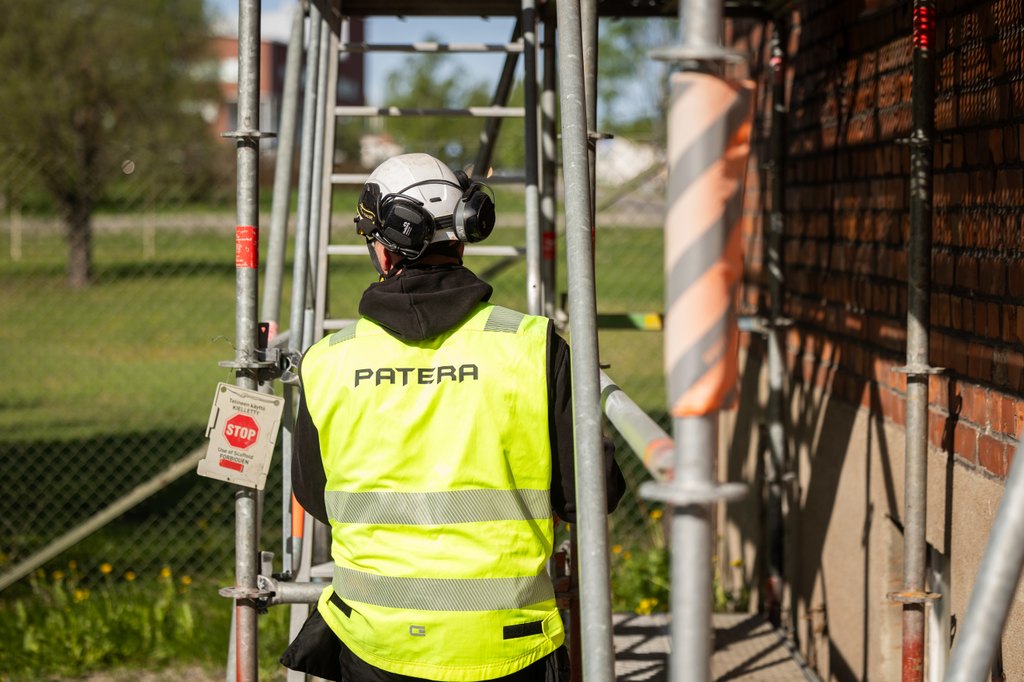
Scaffolding is an essential part of working safely on construction sites and during annual maintenance shutdowns in industry. However, the quality and safety of scaffolding can be compromised if the scaffolding is not inspected properly or if the inspection is the responsibility of unqualified persons.
Patera has carried out hundreds of scaffolding inspections in 2024, in which numerous deficiencies have been detected. Our experts have found that without external, professional scaffolding supervision, up to 9 out of 10 scaffolding installations would have some kinds of deficiencies.
For this article, we gathered insights from three of our experts: Mika Möttönen, Mikko Kirjavainen and Kalle Raatikainen.
Deficiencies in scaffolding and typical hazards
On construction sites, rush and time pressure often lead to scaffolding safety regulations being neglected. Typical errors include not installing railings and toe boards, or anchoring weather protection poorly. In particular, scaffolding that is to be dismantled soon is often left inadequate, which increases the risk of accidents. Also, when it comes to weather protection, plans and drawings are not always followed, which can lead to dangerous situations.
“If you don’t use a scaffolding inspector who knows what to do, practically all scaffolding has some deficiencies. Of course, there are exceptions, but taking all scaffolding legislation into account and building scaffolding accordingly without external supervision is really rare”, says Mika Möttönen.
The situation is similar in the case of annual maintenance shutdowns in industry. When constructing scaffolding, it is often difficult for scaffolders to understand what kinds of work phases will be carried out on the scaffolding and how the surrounding working environment can change. In addition, scaffolding used in industrial environments can be exposed to weather conditions and chemicals, which will impair its safety over time. The scaffolding can rust or corrode, for example, which can lead to serious hazards.
Scaffolding supervision is key to ensuring safety
It is not enough for scaffolders to carry out their own inspections, as they have neither the opportunity nor motivation to ensure that all safety rules are met, considering the rush and pressure of the site. An impartial third-party inspection, on the other hand, provides transparency and ensures that scaffolding meets all legal requirements.
Without external supervision, deficiencies often go unrepaired, and the condition of scaffolding can deteriorate over time. This applies not only to the load-bearing capacity of the structures, but also to the railings and anchoring of scaffolding, for example, which may be illegal or dangerous.
Inadequate orientation and hurry are typical problems
The most common problems in the construction and inspection of scaffolding are inadequate orientation and rush. Scaffolders often learn their jobs from others, who may have inadequate knowledge, which leads to incorrect practices. In addition, scaffolding construction is often seen as auxiliary work, which can reduce its appreciation on the site.
Typical hazards on sites include neglect of tidiness and order, non-compliance with safety regulations for lifting work, and deficiencies in scaffolding safety. During annual maintenance shutdowns and in factory environments, hazards are caused in particular by the violation of safety regulations for hot work and working at height, as well as deficiencies in scaffolding safety and the implementation of written work and rescue plans. Many safety aspects are often neglected on construction sites for detached houses, cottages and holiday homes, which creates significant risks.
Failure to react to scaffolding deficiencies in time can have serious consequences. In the worst case, inadequate scaffolding can lead to serious accidents or even death. There is a real risk of major accidents if, for example, a large piece of scaffolding collapses.
Cooperation between scaffolding suppliers and clients
Successful scaffolding supervision is based on mutual trust and appreciation between the scaffolding supplier/scaffolding supervisor and the client. The client must be able to trust that the scaffolding supplier will construct the scaffolding correctly and safely. At the same time, the scaffolding supplier must communicate openly and honestly with the client so that all parties understand what requirements are placed on the scaffolding.
In order for cooperation to run smoothly, it is important that both the parties respect each other’s competence and understand that safety is the cornerstone of all operations. Good communication, documentation and anticipation play a key role in ensuring the safety of scaffolding.
Why is external scaffolding supervision worthwhile?
The use of an external scaffolding supervisor has many advantages. First of all, supervision greatly improves scaffolding safety. Our experts have found that scaffolders tend to build scaffolding much more carefully when they know that an external supervisor is coming to carry out an inspection.
External supervision also helps avoid unnecessary repair costs. If deficiencies are detected and repaired later, the client will incur additional costs. It is therefore important that the scaffolding is built correctly from the start.
We have also received good feedback about the cooperation from scaffolding suppliers: When the scaffolding supervisor performs their work with a positive and developing approach, in cooperation with other parties (as our supervisors do), both the scaffolding supplier and the scaffolding client gain valuable knowledge and learn about the latest legal requirements.
Supervision by an external expert also ensures that all legal requirements are met. This provides peace of mind for both the scaffolding supplier and the client and helps ensure that the site is safe for all employees.

