
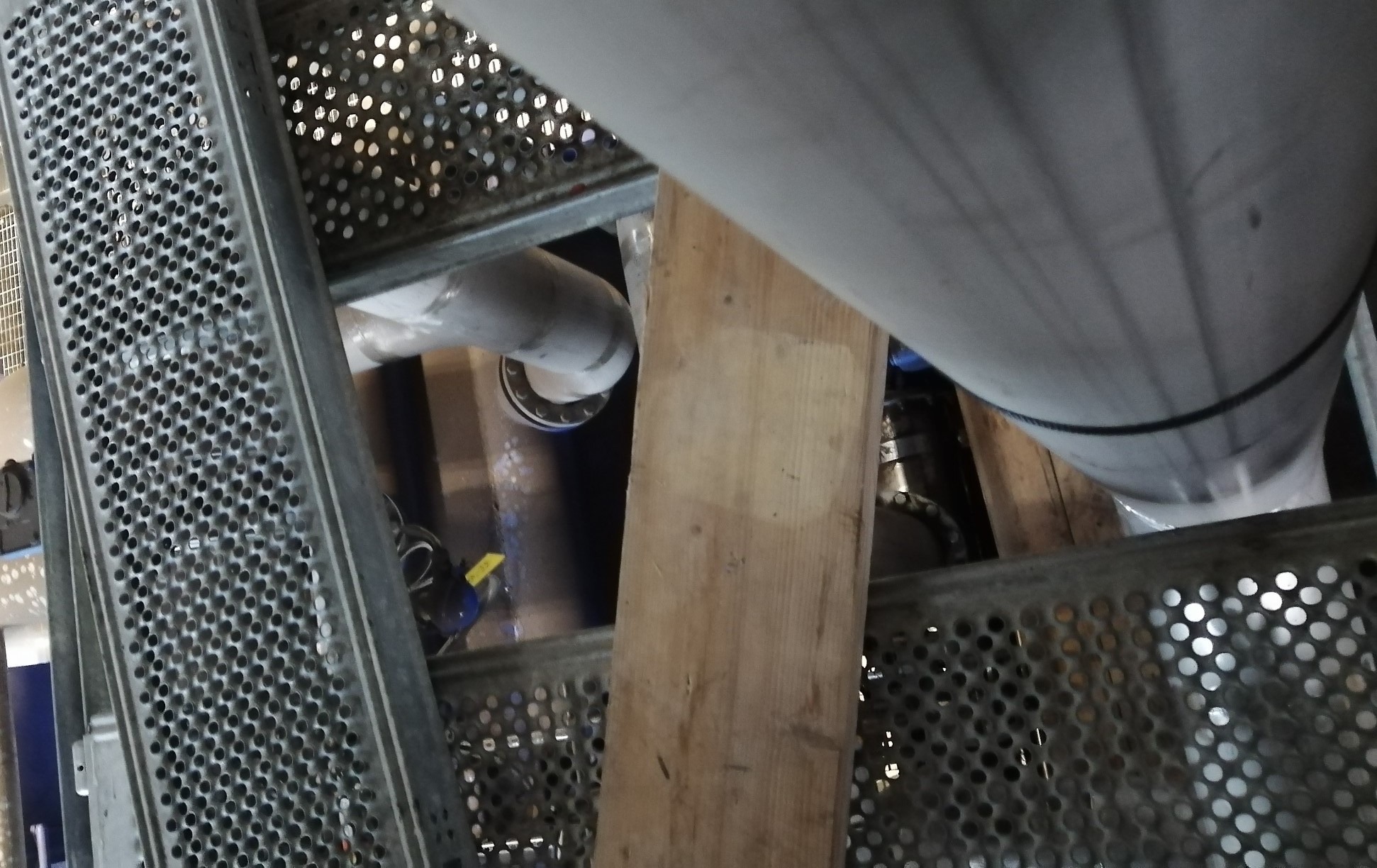
Our photo archives and customer supervision reports show how common it is that scaffolding work platforms are dangerous to use. Almost every report contains recurring observations and images: work platforms have not been installed in accordance with the instructions, openings are too large and uncovered, platforms have been stacked crosswise on top of each other, and openings have been covered with timber in a way that looks like the planks have been left in place by chance.
Unevenness increases the risk of ankle injuries
In training, I show pictures of incorrectly installed work platforms and the accidents caused by them. The participants often say: “That’s exactly what happened with us – the ankle was twisted or broken or the knee twisted when a person fell on an uneven work platform.” The same accidents occur from one site to another.
Together with the customer, we went through an accident that occurred on their site. Once again, the work platforms had been stacked crosswise, creating 3-6 cm high steps, or level differences. A technician stepped onto the edge of the platform, twisting and breaking their ankle. This resulted in a long sick leave, which could have been completely prevented if the platforms had been installed correctly.
Many safe installation parts
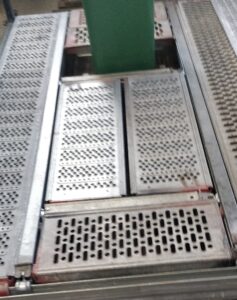
With the right parts, work platforms can be built to be safe and level. Among other things, U-U intermediate runners can be used to change the installation direction of the work platforms to maintain a uniform work surface. Toe boards, railings or covers (missing in the picture below) can be installed around openings.
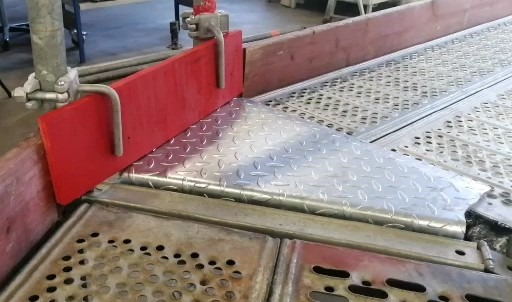
Corners can be covered with corner platforms without timber. This makes it possible to avoid extra fire load, tripping hazards and slow implementation. In addition, there is no need to install raised railings in the corner. If timber is used for covering, it must be remembered that the minimum railing height for scaffolding in Finland is 97 cm. However, the specific characteristics of the work site (RA) may require a higher railing.
The scaffolding client plays a decisive role
The scaffolding client can significantly contribute to the safety of their site. When the client sets clear requirements for scaffolding installations, the safety level of scaffolding work increases considerably.
The previously mentioned ankle fracture, for example, could have been prevented. In the accident investigation, the scaffolding company justified its solution as the “established method of installation” – “This is how things are always done.” The client did not accept the explanation, but stated: “No, they are not. Scaffolding work platforms will never be installed this way again.”
Since this, hazardous installation methods are no longer permitted on the site in question. How to ensure safety: accept only the right and safe solutions.

Author:
Janne Parantainen
Scaffolding Safety Expert And Instructor
+358 40 554 5889
janne.parantainen@patera.fi

