According to law, the scaffolding client is responsible for the safety of use of the scaffolding and maintaining its safety throughout its use. Did you know this was the case, or did the information surprise you?
The majority of clients assume that the party constructing the scaffolding is responsible for the construction, structures and inspection of the scaffolding and for ensuring safety. Of course, the scaffolding company is responsible for building safe and legal scaffolding, but it does not remove the client’s responsibility for ensuring scaffolding safety for their part.
The scaffolding client, the party exercising primary control in the area, is obliged to carry out commissioning and weekly inspections on the scaffolding. The requirement is set out in Government Decree 205/2009 in force on construction sites and the Occupational Safety and Health Act 738/2002 always in force on non-construction sites. In addition, the client must ensure the preservation of operating safety from the construction of the scaffolding all the way to its dismantling and removal.
The main implementer has extensive responsibilities for ensuring safety, and scaffolding safety is part of this required package. The rapid increase in the use of scaffolding on construction sites, as well as in normal industrial operations and maintenance shutdowns, has led to clients not knowing that they are personally responsible for scaffolding and its operating safety to such a broad extent.
In the past, installations were done by ladder without scaffolding, and scaffolding work was an “auxiliary job” that was not appreciated and was believed to be possible for anyone. Today, the situation is different; scaffolding construction is a job that requires special professional skills and is appreciated. The same requirements for scaffolding construction have existed for years, but only recent developments, such as the increased awareness of rules and requirements caused by scaffolding supervision and the continuous improvement of safety, have helped clients understand their extensive responsibilities with regard to scaffolding work. In other words, scaffolding has had to be constructed in accordance with the manufacturer’s instructions and legal requirements up to now – nothing has changed in terms of the rules – but clients’ unawareness of the requirements has meant that scaffolding has not always been safe to use.
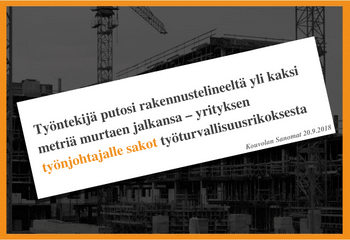
Unfortunately, the main implementer’s responsibility for scaffolding safety is usually understood too late; something unfortunate may have happened, and when the case goes to the prosecutor, the matter is only then understood concretely. In the case of the magazine title image at the beginning of the blog, the person responsible for inspecting scaffolding on the site was fined for an occupational safety violation. It was also noteworthy that the person did not even know that the scaffolding had been built, which, according to the court, did not remove their responsibility for carrying out a commissioning inspection or ensuring scaffolding safety.
It must also be remembered that damage or an accident need not even occur for the responsibility to materialise; if things are not in order, the main implementer may be convicted for an occupational safety violation.
Major and serious accidents happen on scaffolding every year; a quick search on a search engine will reveal the truth. In one of the most recent incidents, an employee fell in Salo on 20 July 2021, when the scaffolding work platform failed and the person fell to a lower work platform, suffering serious injury.
If you are the main implementer or the party ordering scaffolding, find out your responsibilities and identify the risks – anticipation wins over reaction.
Author:
Janne Parantainen
Scaffolding safety expert
+358 44 236 2030
janne.parantainen@patera.fi