
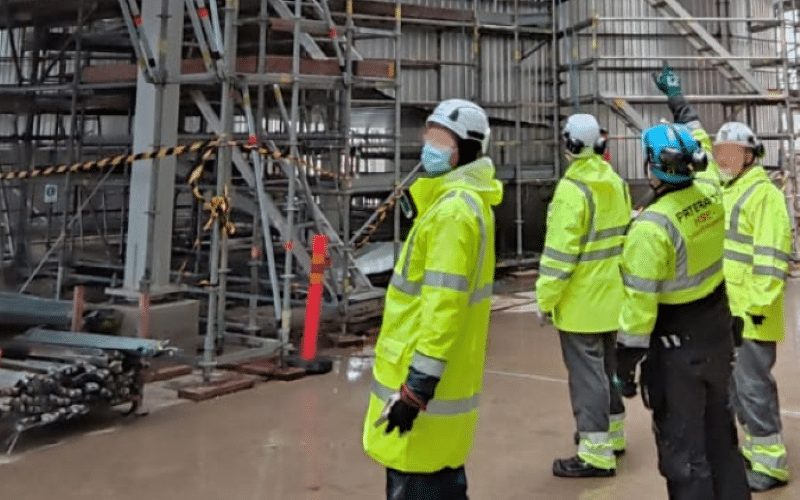
As the main implementer, have you verified the competence of your company’s scaffolding clients to carry out commissioning and weekly inspections on scaffolding? What if you have not?
Legislation and operating instructions require adequate training
The Occupational Safety and Health Act requires scaffolding to be inspected before first use and at regular intervals. The person carrying out the inspection must be a person qualified for the task, in the service of the employer or another person. The scaffolding manufacturer’s instructions must be taken into account appropriately in the inspection.
The operating instructions of one of the major scaffolding manufacturers require compliance with the legislation of the country of use. They also state that the employer providing the scaffolding to its employees is responsible for maintaining the safety of use of the scaffolding. When combining a legal requirement with the manufacturer’s operating instructions, the scaffolding client, which is the party exercising primary control, is responsible for the scaffolding’s inspections and operating safety.
All persons ordering and introducing scaffolding should be trained. According to Section 14 of the Occupational Safety and Health Act, the employer must provide instruction and guidance to the employee and provide sufficient orientation before the introduction of new scaffolding. Training must also be rearranged at regular intervals and immediately when, for example, the work is new to the employee, the work tasks change, safety instructions are neglected, or an accident occurs at the workplace.
Competence can be purchased, but responsibility cannot
Use of an external person as an inspector? According to the Occupational Safety and Health Act, it is possible to use an external expert, a sufficiently qualified person, as a scaffolding inspector. It must be remembered that competence can be purchased, but responsibility cannot.
Often, the scaffolding company is used “blindly” as an inspector, trusting in their competence as the commissioner of the scaffolding. However, the risk of accidents is increased by the operating method used by some of the clients, where each scaffolding installation group can commission the scaffolding themselves and the scaffolding client does not even visit the scaffolding. Has the client verified the competence of the inspectors? What should be done according to law when using an external inspector? The main implementer also has the ultimate responsibility in this matter.
The statement “I have done this for 15 years” is no proof of the inspector’s competence. People responding this way are often accustomed to old ways; when you talk to the person about the matter, it turns out that they don’t actually know current legislation or the manufacturer’s operating instructions.
How to ensure the quality of training
In Finland, the training of scaffolding inspectors is inadequate. I called an instructor and asked them how they can give a permit to inspect scaffolding up to a height of 10 metres through online training. The answer was: “I don’t give it; I send the cards to the employer, who can decide whether to give them to their employees”… There is no legislation on training in Finland. The employer is ultimately responsible for verifying the adequacy and competence of the training.
Main implementers, ask the parties providing training for you if they still stand behind the material they have used in the training even when something unfortunate happens. Will they then say: “No worries, the things covered by my training are all based on up-to-date, verified information, and you have done exactly the right thing”?
This way, you will know whether your personnel will receive “training” or TRAINING in the future.
Read about Patera’s training courses
Author:
Janne Parantainen
Scaffolding safety instructor
+358 44 236 2030
janne.parantainen@patera.fi

